Searching for Cyclic TV Reference Paradoxes
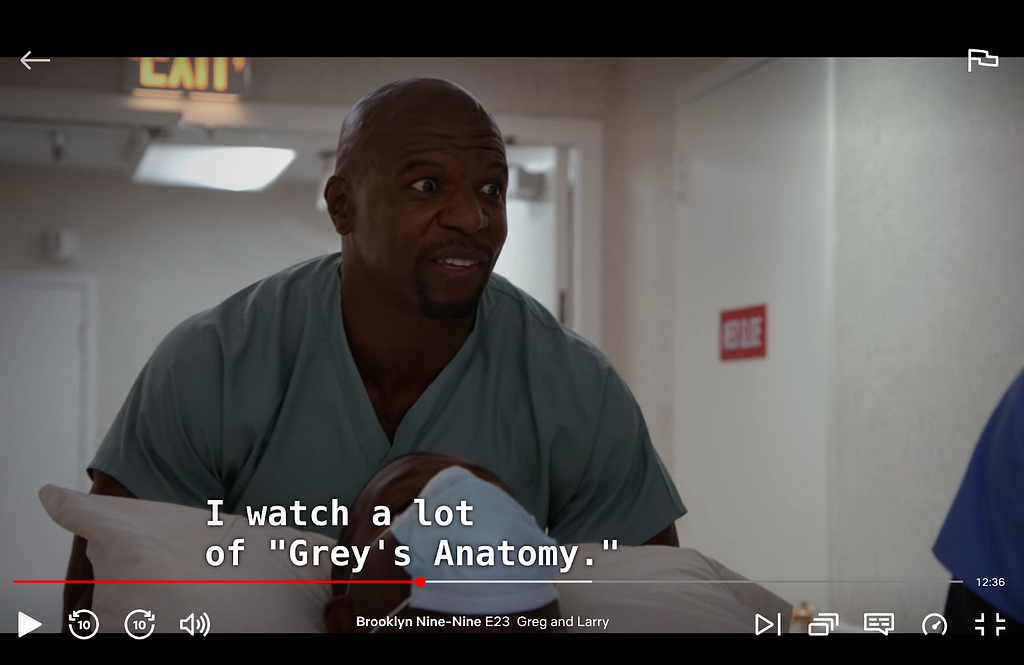
A while back I was watching Brooklyn Nine-Nine and came across this particular line — I watch a lot of Grey’s Anatomy. At first glance, there isn’t anything too special about this. But after some more thought, I realized there was a deeper implication to this singular line — in the fictional universe that Brooklyn Nine-Nine takes place in, Grey’s Anatomy exists as a TV show. More and more, I started noticing these sorts of fictional references across many different TV shows. Eventually, this got me wondering what would happen if a bunch of references like these formed a cycle? Such as if Grey’s Anatomy also referenced Brooklyn Nine-Nine. If that were to happen, both shows would be relying on the other being fictional in their respective universes, which cannot both be true simultaneously — a paradox!
There are a couple of well-documented pop culture paradoxes, however, I couldn’t find one that covers this exact situation (if you know of one, let me know!), so I’ve decided to call them Cyclic TV Reference Paradoxes. Since there’s no governing body that dictates what shows can and cannot be referenced by other shows, these paradoxes must come up — right? Due to a mixture of boredom and curiosity, I decided to find out for certain.
Defining the Search Scope
Right off the bat, I decided to limit the scope of my search to exclusively TV shows which have the nice property of being released as episodes over some period of time. This allows them to temporally overlap with other TV shows enabling them to reference one another while they’re both actively being produced. It would be impossible for two movies to do this as one would be produced before the other even existed. Additionally, I decided to focus on popular TV shows as I guessed these would be the most likely to be referenced by other shows.
Then, to find these paradoxes, I realized I would need a lot of TV references. I quickly found a few Fandom wikis for certain TV shows that contain fan-maintained lists of outward references (see Outside references to Lost). Unfortunately, these were pretty sparse and were not consistent across Fandoms. The next best option I had was to look at the subtitles for TV shows. By searching the dialog for names of other TV shows, direct references could be found. This would miss out on indirect references (ie. mentioning “Baby Yoda” to reference The Mandalorian), but they weren’t entirely required for this project’s needs.
The Technicals
The first step was then getting all the required subtitles. Easier said than done. Subtitles were scattered across many different services and platforms. Luckily, I stumbled across Subliminal — a python library that abstracts this complexity away and fetches subtitles across multiple subtitles providers. Pairing this with TMDB’s API — a great source on TV show metadata (names, popularity, episode/season counts), I managed to download over 40,000 subtitle files over a couple of days.
Great. However, this amounted to over 5 million lines of subtitles. To do anything meaningful with this amount of data, it needed to be indexed in some way. I ingested all the subtitle data into Whoosh — a python text-searching library, allowing for quick, fuzzy searches to be done to find subtitles. From there, I could quickly search the names of different TV shows to find references to them within other shows’ dialog.
Some Subtleties
Unfortunately, this didn’t work great right away, there were a couple of subtleties that had to be accounted for:
- Generic names — TV shows like “Suits” returned a ton of false positives. To account for that, I dropped all TV shows with names that were too generic, leaving ~300 TV shows.
- Intra-universe References — It became apparent that TV shows would often reference other TV shows in the same cinematic universe as a form of cross-promotion. Since these sorts of references weren’t fictional (ie. referencing “The Flash” from “Arrow”), I dropped any references between TV shows in the same universe.
- Linguistic Context — There’s a big difference between “did you watch stranger things?” and “stranger things have happened”. Understanding the linguistic context of the dialog was out of scope for the nature of this project, so I ended up manually filtering all references as a final step.
Accounting for these nuances, I was left with a total of 2192 TV references. There had to be at least one cycle in there!
Finding Cycles
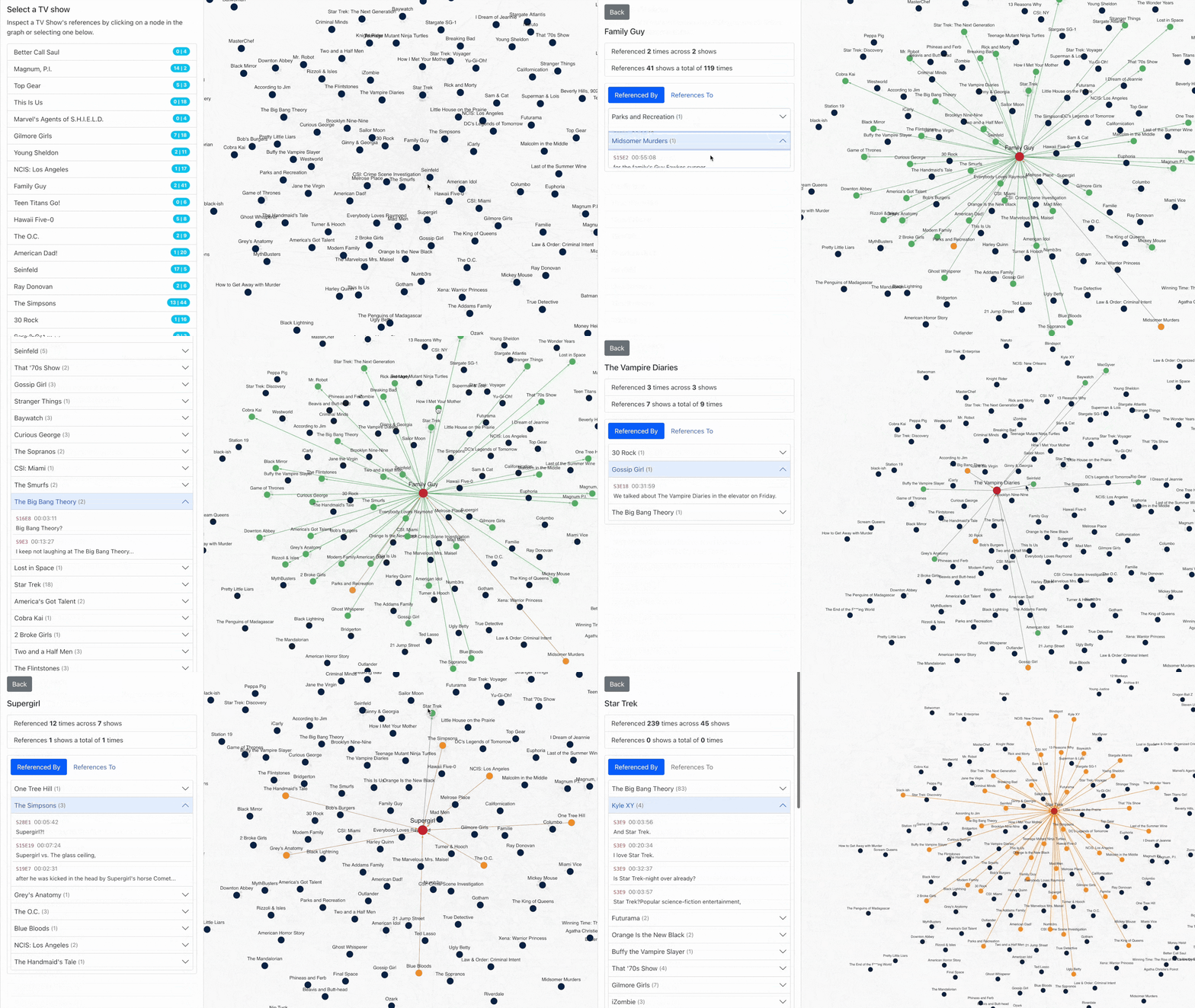
I built a React web app that visualized the TV reference data in a graph. Each node in the graph represents a TV show, and the edges indicate that a TV show references another one (possibly multiple times).
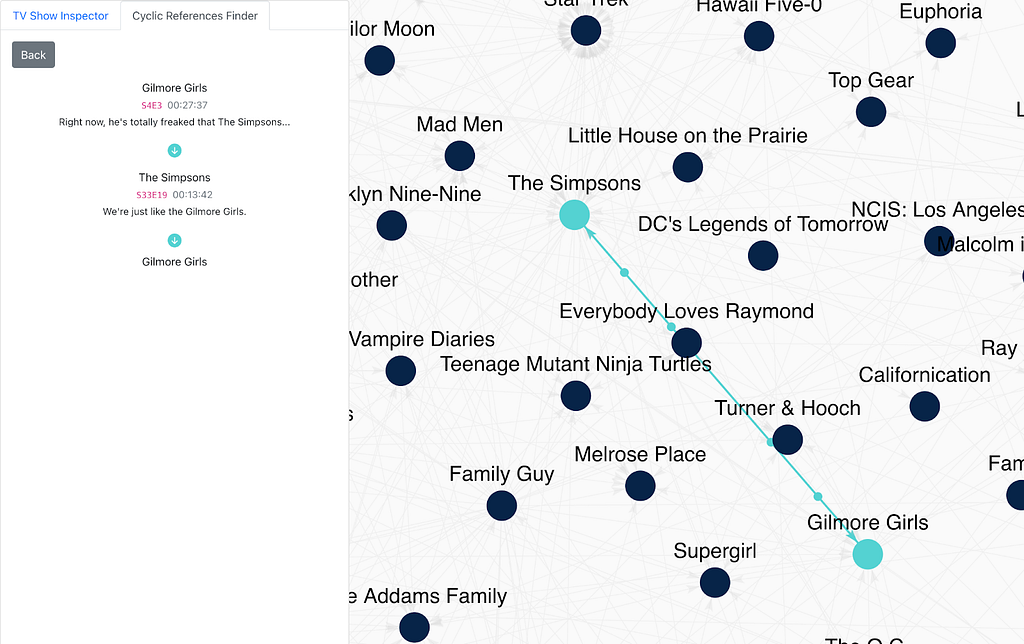
The web app runs a depth-first search to find any cycles, and was able to find a total of 72 Cyclic TV Reference Paradoxes!
Some were small — just two TV shows referencing each other. Others were much larger and more intricate — being made up of many TV shows (the largest being made up of 12).
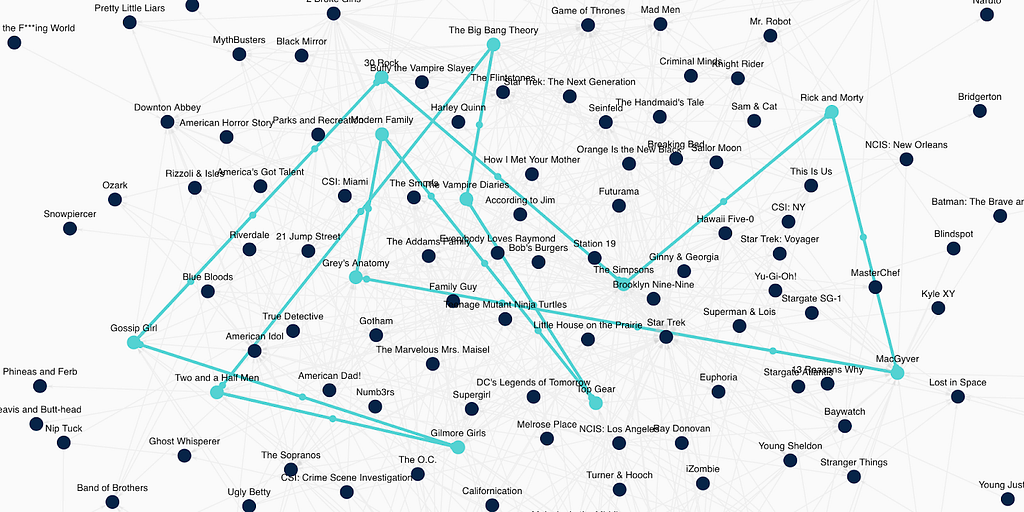
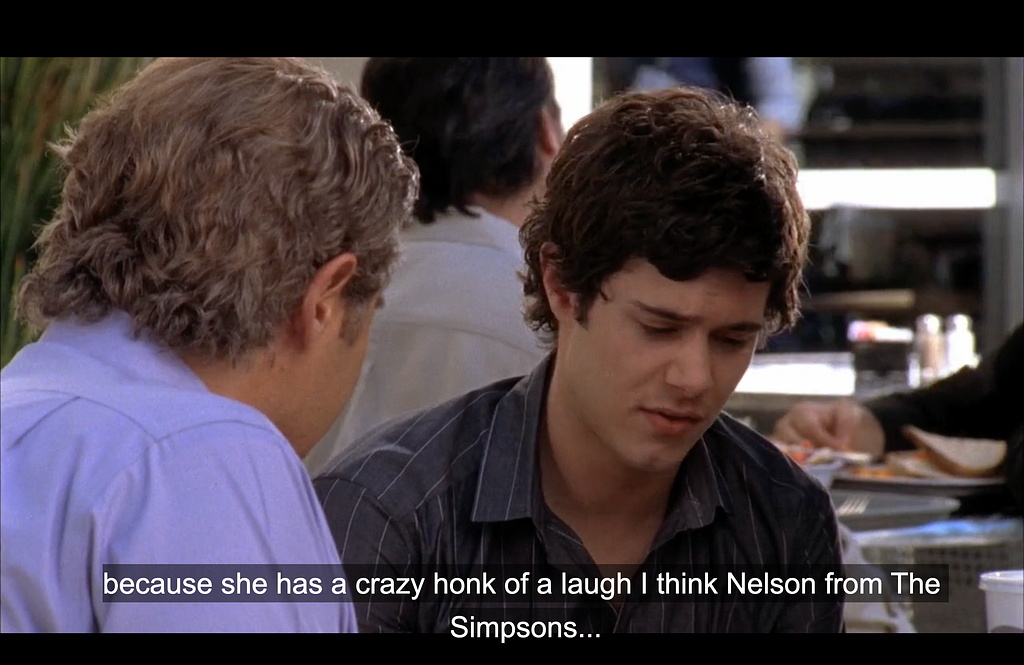
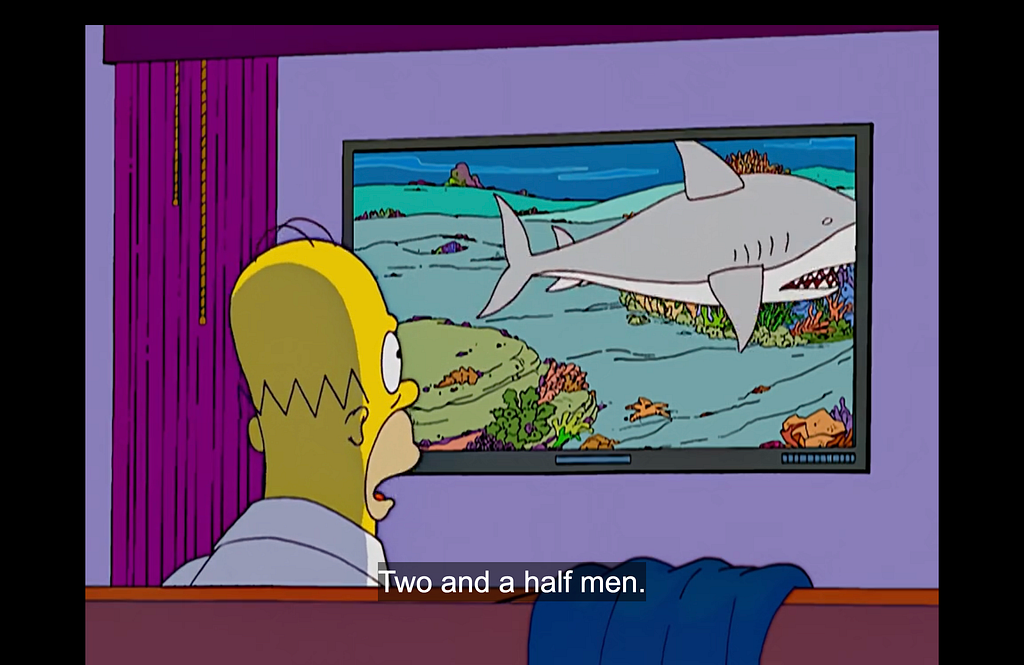
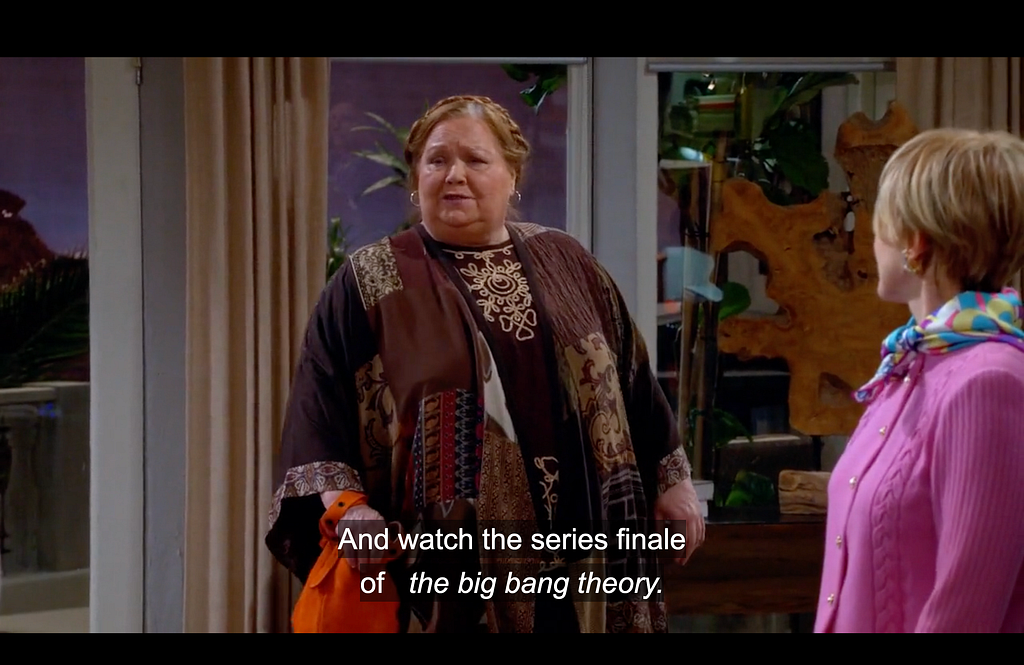
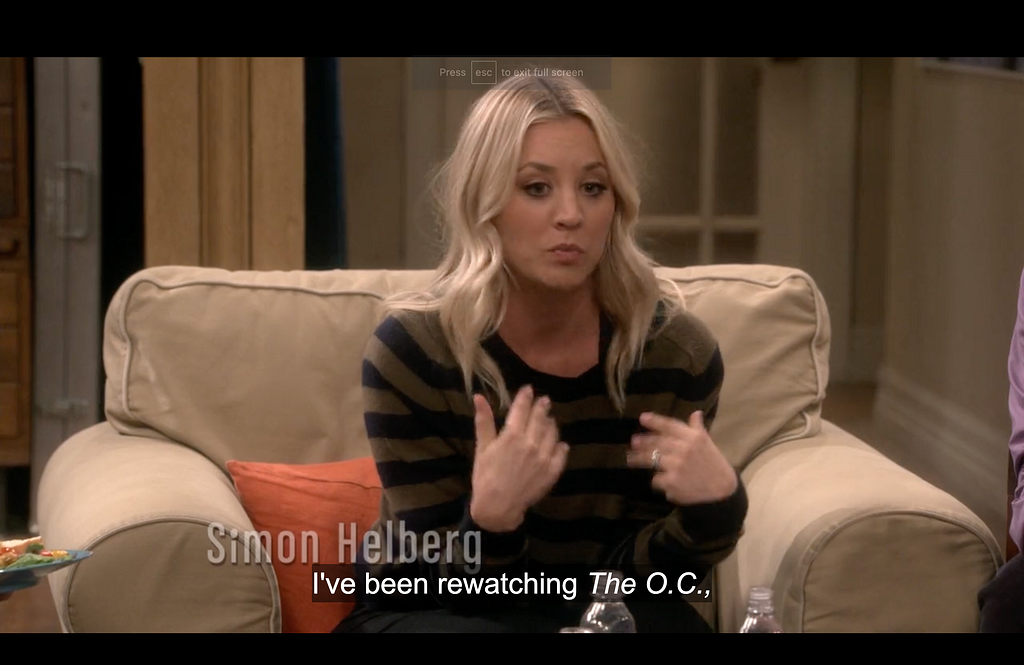
All in all, it was quite cool finding these cycles and proving the existence of these paradoxes. Here’s a set of screencaps illustrating another one of these paradoxes.
Other Findings
There were some other interesting findings this tool could illustrate well. The most referenced show was unsurprisingly Star Trek. It was referenced 239 times across 45 shows. Interestingly, there weren’t any outwards references from Star Trek due to it being an older show. The show that references the most other shows was The Simpsons, referencing 44 shows a total of 127 times. The Simpsons was actually a part of every cycle found, which makes sense given how frequently it both references other shows, and is referenced.
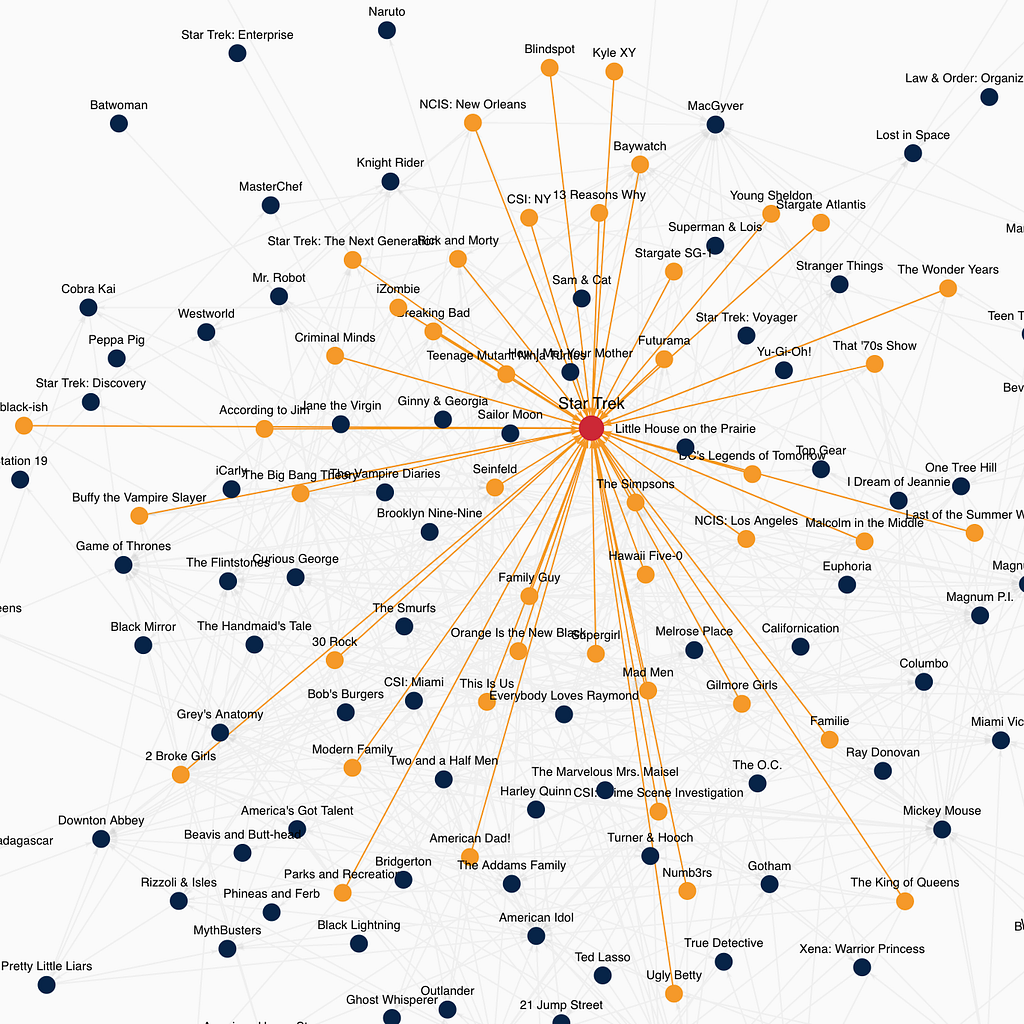
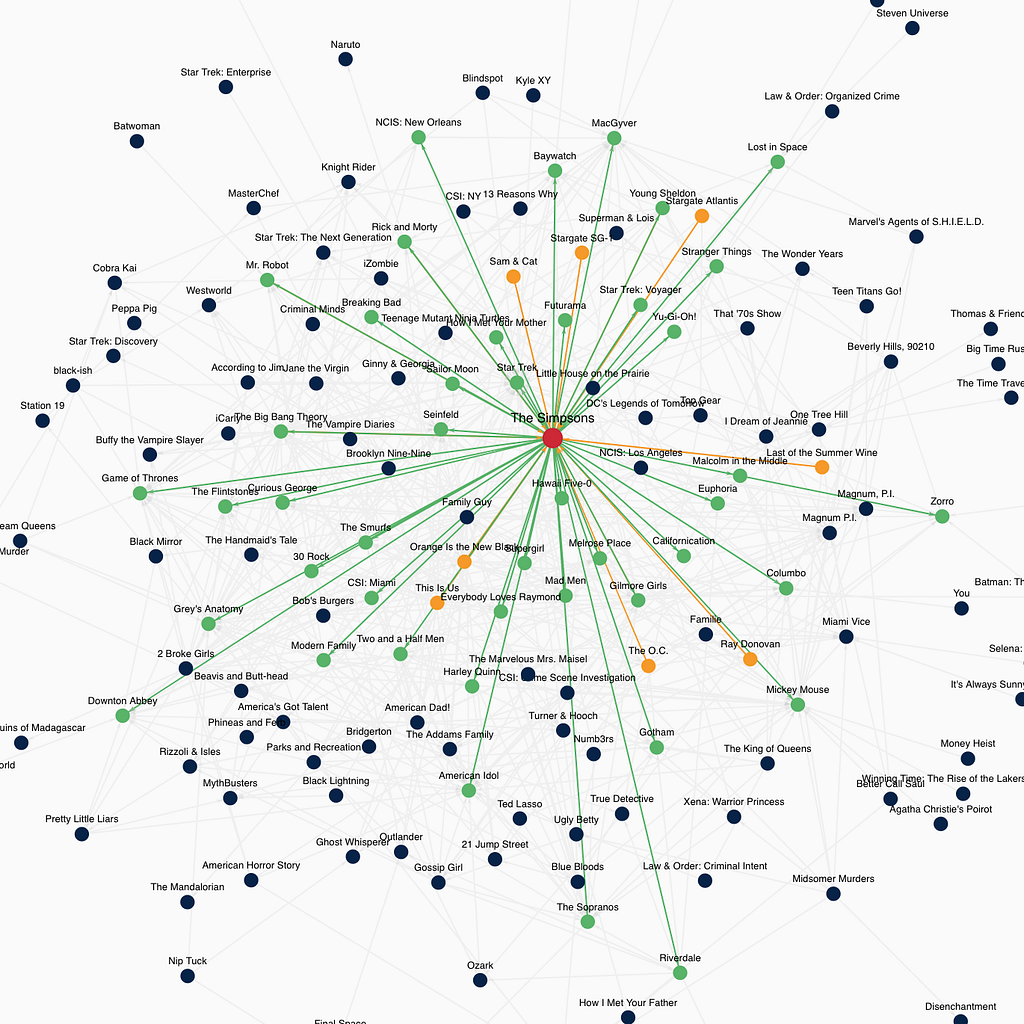
Looking through more shows, a pattern formed where more comedic shows (ie. The Big Bang Theory, Family Guy…) would reference other shows more often. Conversely, more serious shows (ie. Grey’s Anatomy, Game of Thrones…) would be referenced frequently, yet never reference other shows. It appears relevancy — through the use of external references, help shows come off as funny.
So now what?
With this project, the existence of Cyclic TV Reference Paradoxes has been shown. Does this have any real-world consequences? Not really. I think this is an amusing artifact of scriptwriters including small homages to some of their favorite TV shows. Individually they don’t mean much, but at scale, across hundreds of TV shows, they produce these interesting paradoxes that no writer probably gave a second thought about. The next time you’re watching a TV show and see one of these references, you can now rest assured that the reference is probably a part of a much larger, unintended paradox.
Resources
- Cyclic TV Reference Paradox Finder: https://jamiepinheiro.com/cyclic_tv_reference_paradox_finder
- Source code: https://github.com/jamiepinheiro/cyclic_tv_reference_paradox_finder